
Prepare and run a billing cycle
Use Billing Cycles to bill a site for a period such as September. Start with a preview, check the figures, then run the billing when you are ready to create the records.
The first run is called provisional billing. It creates charges and parent invoices, so treat it as issuing bills even though you can reconcile differences later.
1. Choose the site and period
Section titled “1. Choose the site and period”Open Billing → Billing Cycles. Choose the month and use the site or frequency filters to find the period you want.
Check the site name and the period’s start and end dates. A run date can fall before the care period begins; it follows the site’s billing cycle policy.
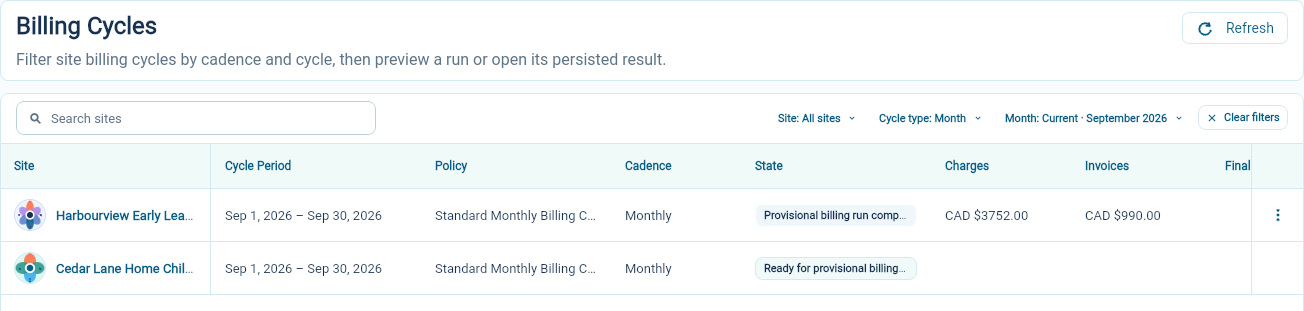
Example: Harbourview has created September billing. Cedar Lane has no posted September amounts yet. Empty totals do not mean the site’s care is free.
2. Check what is ready
Section titled “2. Check what is ready”Make sure the program’s rates and the children’s enrollments are ready for the period. Pay particular attention to new starters, changed schedules, guarantees ending and subsidy approvals.
Review the site’s calendar, including planned closures and parent-notification dates. Complete the calendar review requested by the cycle once you have checked it.
The cycle may also depend on completing the previous period’s work. Follow the reason shown for anything that is not ready rather than trying to start another cycle for the same dates.
3. Open the provisional preview
Section titled “3. Open the provisional preview”The preview shows the calculation before you create bills. Begin with Calculation Summary, then look at Service Calendar and Enrollments.
Check more than the grand total:
- Does the preview include the expected children?
- Are their chargeable days right?
- Are holidays and closures treated as agreed?
- Are the parent and funding shares reasonable?
- For a home, does the remittance amount make sense under the home’s policy?
Open a child’s calculation when an amount needs a closer look. A three-day schedule should not be checked against the same number of days as a five-day schedule.
4. Put mistakes right before running
Section titled “4. Put mistakes right before running”If a rate, schedule, closure or funding approval is wrong, correct that information and review a fresh preview. A preview is useful only when it reflects the information you intend to bill from.
For example, if a subsidy starts on September 10, do not expect it to reduce charges from September 1. Fix the authorization only if the approval itself says the earlier date is correct.
5. Run provisional billing
Section titled “5. Run provisional billing”When the preview is right, select Run Provisional Billing.
AmalynCare creates the charges and issues the parent invoices for that run. For a home with an applicable remittance policy, it also creates the home remittance records.
Issuing an invoice is different from receiving payment. Likewise, creating a home payable records what is owed; it does not confirm that a bank transfer has happened.
6. Check the result
Section titled “6. Check the result”Review the numbers of charges and invoices created and compare the totals with the preview. Parent invoice totals may be lower than total charges because other payers cover part of the tuition.
If you see an error after running billing, check the cycle list before trying again. The billing records may have been created even if the result page did not open. Get help if you cannot confirm what happened.
Later, use actuals billing to check the completed period and deal with differences.