
Monthly billing for a centre
For a centre, the monthly routine is to check the children’s arrangements, review the calendar, create parent bills, and then check the completed period for differences.
Here we use Harbourview Early Learning Centre as an example. The families, rates and funding amounts were created for these guides.
Before the first monthly run
Section titled “Before the first monthly run”Check that the site has the intended billing cycle policy and that each program has tuition and a service-day policy. Then review each child’s schedule, billing contact and funding.
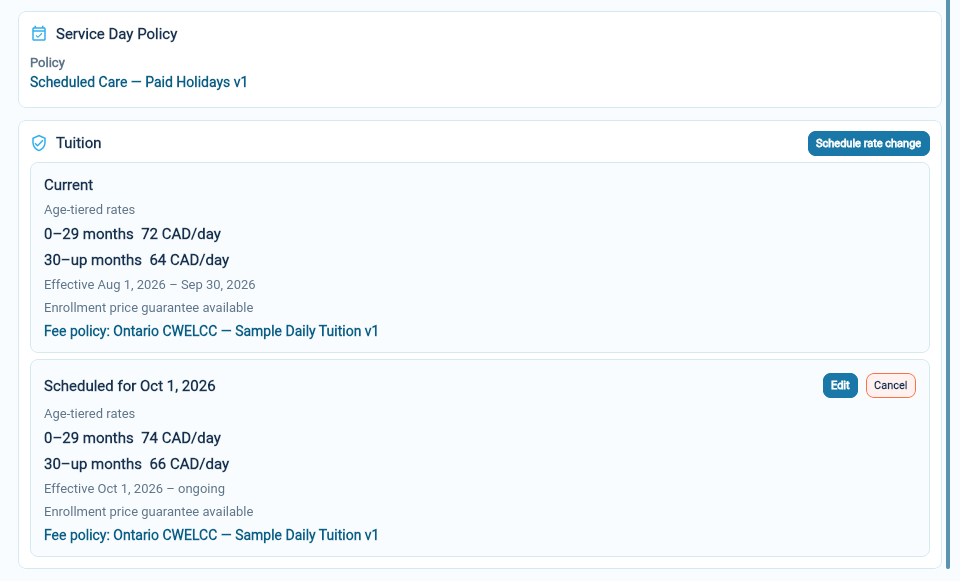
Harbourview’s example program has two daily rates: $72 for ages 0–29 months and $64 for ages 30 months and over. An October increase is already scheduled, so both the current and next rates are visible.
For setup details, use tuition rates and guarantees and enrollment billing and funding.
Check the children included this month
Section titled “Check the children included this month”Harbourview has three example enrollments:
| Child | Agreed days | Funding to check |
|---|---|---|
| Oliver | Monday–Friday | A $12 daily subsidy on eligible days. |
| Sofia | Monday, Wednesday and Friday | No child-specific subsidy. |
| Leo | Monday–Friday | No child-specific subsidy. |
All three use the program’s example fee policy. A child without a subsidy can still receive the fee reduction provided by that policy.
Before billing a new month, check for starters, leavers, changed weekdays and expiring approvals. The previous month’s list is a useful reference, but it is not a substitute for checking this month’s arrangements.
Review the calendar and preview September
Section titled “Review the calendar and preview September”In Billing Cycles, find Harbourview’s September period. Review holidays and closures, complete the requested calendar review, and open the provisional preview.
Look at each child’s chargeable days and family share. Sofia’s three-day schedule should produce a different number of days from Oliver’s and Leo’s five-day schedules.
In our saved September example, total tuition charges are $3,752, while the three parent invoices total $990. The difference is covered by the public funding and subsidy shares in the example.
A smaller parent total does not mean some tuition was forgotten. Check the split between payers before deciding that the bill is wrong.
Create and check the bills
Section titled “Create and check the bills”Once the preview is correct, run provisional billing and review the result. Confirm that the expected invoices were created for the correct period.
Use prepare and run a billing cycle for the steps. Remember that issuing the bills does not confirm that families have paid them.
Return to the completed period
Section titled “Return to the completed period”After the period, make sure the calendar and other billing information are accurate, then review actuals. Explain any resulting charge or credit with the dates and reason behind it.
For a late subsidy approval, also check whether a separate payer correction needs attention. Actuals billing and subsidy corrections cover those two reviews.
When families ask about an amount, the invoice guide gives you a shared starting point for the conversation.