
Home remittance and later adjustments
Home remittance is the amount an agency owes a home child care operator under the home’s remittance policy. It is separate from the bills sent to families.
A family may pay only part of the tuition because funding covers the rest. The home’s calculation can also include additional amounts set by the agency’s policy. That is why the home payment is not simply the total of the parent invoices.
Start with the home’s policy
Section titled “Start with the home’s policy”In Organization Settings → Home Remittance Policies, the agency can review the policy used by the home.
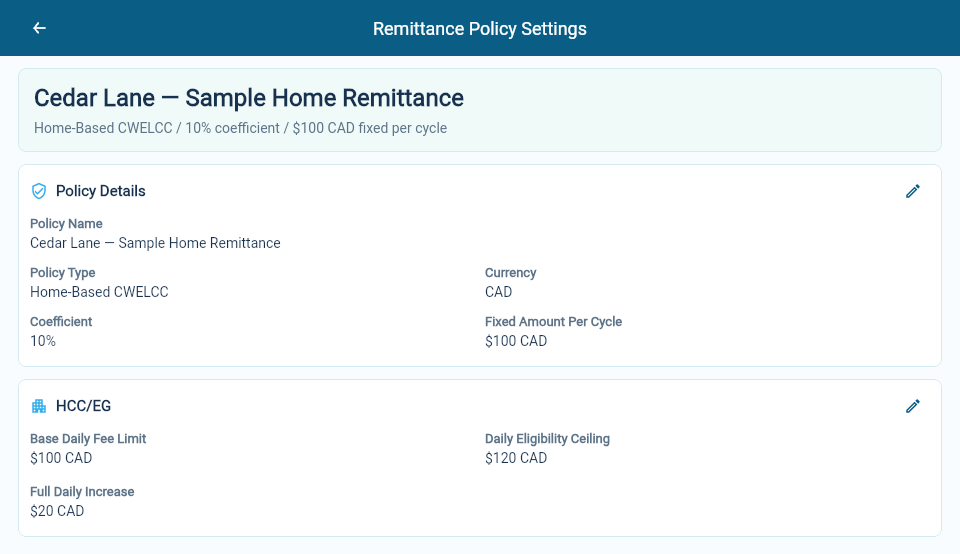
This is an example policy. The percentage, fixed amount and HCC/EG values are illustration settings, not prescribed rates.
Depending on the policy, the calculation can include:
- Base amount: the care amounts included for the children in the cycle.
- Percentage amount: an addition calculated using the policy’s coefficient, or percentage.
- Fixed amount: a set cycle amount, adjusted for open service days where required by the formula.
- HCC/EG: the home child care enhancement amount, where the policy provides for it.
- Earlier adjustments: amounts brought into this cycle from previous work.
Check which period each line belongs to. Some amounts are calculated now but included in a later cycle.
Advice, payable and payment
Section titled “Advice, payable and payment”These three records have different jobs:
| Record | What it tells you |
|---|---|
| Remittance advice | How the home’s amount was worked out. |
| Payable | What the agency owes the home operator. |
| Payment | What has actually been paid through the agency’s payment process. |
An advice or payable does not confirm a bank transfer. If you are checking whether money has arrived, use the agency’s payment information as well.
What changes after actuals
Section titled “What changes after actuals”The first remittance uses the information available at provisional billing. Actuals later checks the completed period.
If that review changes the home’s amount, the difference is reconciled with a later provisional remittance. A later advice can therefore contain this period’s care and an adjustment for an earlier period.
For example, an unpaid closure recorded after the first run may reduce an earlier amount. Look for the original period and the adjustment together when explaining the change to the home operator.
Amounts held for a later cycle
Section titled “Amounts held for a later cycle”The home-based CWELCC formula can calculate a current-cycle HCC/EG amount for inclusion in the next cycle. That is why an enhancement may appear as deferred rather than included in the current payable.
“Deferred” means its payment treatment belongs to a later cycle. It should not be counted twice when comparing the two statements.
Carried balances
Section titled “Carried balances”A reduction can be larger than the current amount available to pay. The remaining balance can then carry forward and reduce a later payable, rather than appearing as a negative bank payment.
Review the opening balance, the amount used in this cycle and any balance left over. The carried balance belongs to the home site. If the operator changes, the agency should check the site’s balance as well as the current payee.
For an unexplained difference, start with the home, care period and advice being questioned. Compare the calendar, policy and earlier adjustments before changing any figure. Agency teams can follow monthly billing for a home agency for the full routine.